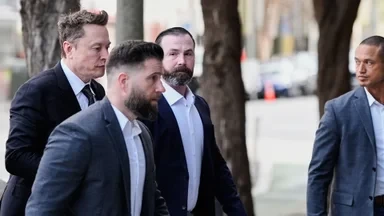
Elon Musk Defends Himself in Jury Trial Over Twitter Takeover Deception Claims
On Wednesday, a defiant Elon Musk took the witness stand in a San Francisco civil jury trial, pushing back against allegations that he engaged in repeated deceptive conduct to mislead investors while trying to walk away from his $44 billion agreement to buy Twitter before ultimately completing the takeover.
The trial centers on a class-action lawsuit filed just before Musk took control of Twitter (the social platform he later rebranded as X) in October 2022, six months after he first agreed to purchase the struggling company for $44 billion, or $54.20 per share. For the world’s richest person, that purchase price makes up just a tiny fraction of his current estimated total net worth of $841 billion.
The suit represents Twitter shareholders who sold their stock between May 13 and October 4, 2022, and revolves around claims that Musk violated federal securities laws. Plaintiffs argue he took a series of calculated steps to deliberately drive down Twitter’s share price, either to kill the deal entirely or negotiate a lower purchase price.
Musk has long maintained the deal deserved renegotiation or termination, claiming Twitter’s board misled him about the share of the platform’s accounts that are fake or automated “bots.” He doubled down on this stance during Wednesday’s testimony, where he appeared in a dark suit and tie. When asked if he threatened to “hunt down” Twitter’s board unless they reopened negotiations to adjust the purchase price, Musk did not rule out the possibility, a response that underscored the bitter acrimony surrounding the deal.
“There were a lot of threats going back and forth from both sides,” Musk said. “I was pretty upset with the Twitter board because I felt they had engaged in fraud.”
Concerns over bots and fake accounts were not new when Musk negotiated the deal. In 2021, Twitter paid $809.5 million to settle claims that it had overstated its user growth rate and monthly active user counts. For years, the company also shared its bot estimates with the U.S. Securities and Exchange Commission, while regularly cautioning that its count could be too low. During Wednesday’s testimony, Musk repeatedly dismissed the data provided by Twitter’s board as nonsense, using the blunt slang abbreviation BS.
“I did make it clear that I thought it was BS,” Musk said of Twitter’s calculation that only around 5% of its accounts were bots.
The suit accuses Musk of making a string of misleading statements about the deal before he formally announced he was pulling out of the agreement in July 2022. After Musk backed out, Twitter sued him in Delaware to force him to honor the original deal. On the eve of that Delaware trial, Musk reversed course again and agreed to close the purchase at the original price he had promised.
Musk testified Wednesday that he ultimately completed the deal because his legal team advised him that Kathleen St. Jude McCormick, the Delaware Chancery Court chancellor overseeing the case, was “extremely biased” against him and he had no chance of winning. He noted that McCormick later voided a $55 billion pay package awarded to him as Tesla’s CEO, but that ruling was not issued until January 2024 — 15 months after he closed the Twitter takeover. The Delaware Supreme Court overturned McCormick’s ruling on the pay package late last year.
By framing his belief about McCormick’s bias as advice from his attorneys, Musk sought to avoid extensive questioning about his decision to complete the deal, protected by attorney-client privilege. But U.S. District Judge Charles Breyer noted Wednesday that other evidence suggests Musk personally concluded McCormick was biased against him, which could lift the privilege. Breyer indicated he will rule on the matter later in the trial, which is scheduled to run through March 19.
In his testimony, Musk argued that his decision to follow through on the deal at the original purchase price delivered a major windfall to most Twitter shareholders. But while the deal was in limbo, Twitter’s share price fell below $33, roughly 40% lower than Musk’s original per-share purchase price. The lawsuit argues this downturn hurt shareholders who sold their stock during the period of uncertainty created by Musk’s alleged deceptive behavior.
“I can’t control whether people sell their stock, but everyone who held the stock fared extremely well,” Musk said.
This is not the first time Musk has been forced to defend himself in court against claims that he duped investors via his social media posts. Three years ago, he spent roughly eight hours testifying in a San Francisco federal trial tied to his 2018 proposal to take Tesla (the publicly traded electric automaker he still leads) private at $420 per share, a deal that never materialized. A nine-member jury cleared Musk of any wrongdoing in that case.
Before wrapping up his Wednesday testimony, Musk acknowledged that his frequent social media posts often reveal more of his inner thoughts than is typical for public figures. “What I think privately is what I say publicly,” he said. Musk is expected to return to court Thursday to continue his testimony.
Elon Musk Defends Himself in Jury Trial Over Twitter Takeover Deception Claims